As seen above, our culvert pipe planters are being moved out of storage (by Terry and Larry at the top) and will be going thru their next color conversion very shortly. The two large culverts (24" diam
 eter) directly above, which are two of five that size, were wiped down and cleaned up by Urban today and are drying overnight. These five will be converted to a glossy, brilliant white color and will be used in our primary color scheme (silver/white/light blue) this year. These culverts have already been maroon, light blue (as seen) and will have this new look in 2012. We've had lots of comments and questions from visitors regarding these planters and how we install, plant and maintain them out in the gardens. They are such a signficant vertical element that they are bound to attract attention but certainly lend a sense of "scale" in any space the
 y are located. We use plastic garbage can inserts to hold the soil (36" depth or so) and rebar supports keep the container from sliding down in to the pipe. They are not light and their handling can become tricky. We'll also be using the 18" diameter culvert pipes in other locations (color still to be determined...). To the left is a shot provided by Ken T. of our bear sculpture with resident robin (from last spring). I've taken this same shot but not with the same clarity (I couldn't get the robin to smile). What a nice nesting location! To the right is Terry continuing work on his pallet planter. Note the circular openings that we'll use for larger veggies. This planter is on it's side right now but Terry is making two that we'll include out in the gardens this spring. Directly below is the golden foliage of the 'Saybrook Gold' juniper (Juniperus chinensis) in front of the Parker Education Center. I love gold conifers and so many of them become brighter in our winters and lend plenty of color to the otherwise barren landscape.
 Directly above is the "trial bowl" that Marv painted early this week. This is obviously upside down but imagine six of these bowls (27" wide and 7" deep) secured and el
 evated on top of 8" diameter pvc pipe. The entire bowls and supports will be metallic silver and we'll have fun plants spilling out of these. Note the drainage holes. A pot this shallow will be in need of frequent watering and attention but they should look good in our silver/white/light blue theme.
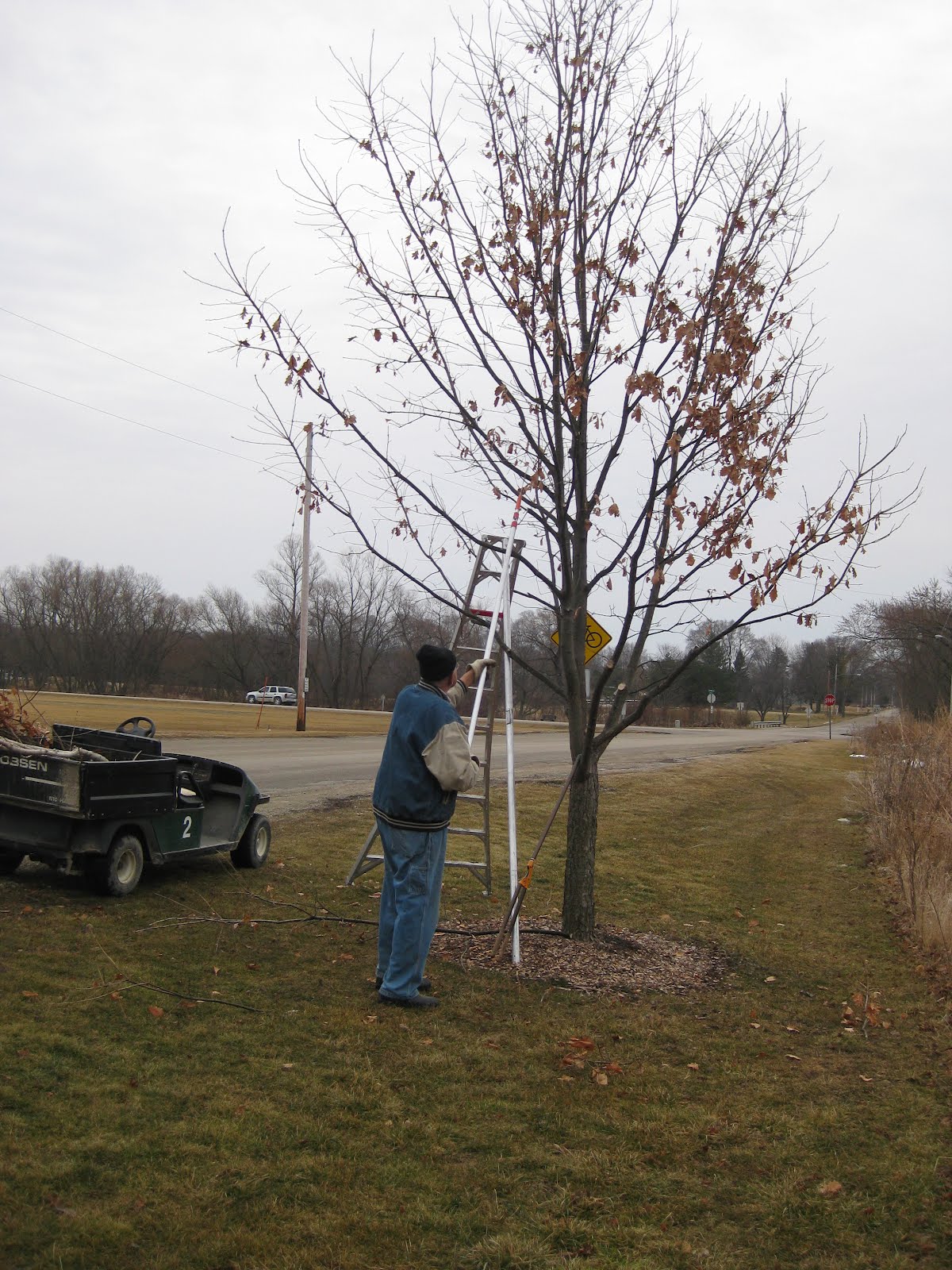
We had a nice turnout of volunteers today. To the right is Urban working on pruning a Heritage oak (Quercus macrocarpa x robur 'Clemons') near our prairie restoration. This oak is a nice cross between the native bur oak and English oak. Dick W. was also out in the gardens cutting back ornamental grasses (see his vehicle further below). We typically leave grasses until late March before cutting them back. However, we have many that don't look
 real good and our visitation right now is minimal. The "cool season" grasses that emerge early are not far away from popping up if we have continued warm weather. We'll take advantage of the weather and get a jump on the early spring cleaning efforts regardless. Gena and Myrt were around yesterday also working on cutting back many of the grasses as well. Larry worked on his signs this morning but was out pruning later in the day. Dave, Jim, Bob A., Vern and Del were all working around the shop on various tasks. Maury was in and ran some errands for us. Janice came in to work on our "Grains of the World" collection and we continue to m
 ake progress with spring plant sale preparations. We also saw Gary and some others today. To the left is the silhouette of a black locust (Robinia pseudoacacia) near our horticulture center. Now is a good time to look at branch structure of your deciduous trees and shrubs to see where you might have issues of crossing/rubbing branches or other issues that should be dealt with immediately. It's a lot easier to observe these features now before the leaves emerge (obviously!).
I'm trying to finish orders for both grounds and our spring plant sale. We'll have a wide range of herbs available for the Spring Plant Sale (May 12-13, 9 am - 4 pm) to go along with veggies, perennials, compost and other offerings. Check out our website at www.rotarybotanicalgardens.org for more information. The available vegetable variety lists for the sale are currently on the website to be followed shortly by the herb listings. To the right are the remnants of the recent removal of a mostly dead yellowwood (Cladrastis kentukea) near the arboretum. You can see how it gets it's name and look at the sawdust in the distance too. Interesting. We're going to plant another one in a different area as it is a beautiful and hardy tree. At the bottom is the remnant flower structure of a goldenrod (Solidago sp.) bloom with a touch of frost in our prairie restoration.


 I wont have much time to blog today as I'll be at RBG for a half day and them heading up to Sturgeon Bay in Door County, WI to do a talk this evening on Color in the Garden. I'm taking my younger daughter with and we'll stay over night with a return tomorrow. Above is a nice shot of the formal annual sections a couple years ago. I believe this image is in my talk for this evening. Look on top of the boxwood (Buxus) hedges to the left and you'll see some light patches. Those are the spider webs with morning dew exposing their location!


 The Perennial Plant Association (PPA) has announced the 'Jack Frost' false forget-me-not (Brunnera macrophylla) as the Perennial Plant of the Year for 2012. Inclu


 With another nice, sunny day, we had plenty of volunteers come in to help out this morning. Directly above is the beginning of our vertical, "pallet planter"


 I stopped in to RBG briefly this morning for a meeting of our Home Garden Tour Committee (also attended by Jean, Bill, Tim, Barb and Cora) at the Horticulture Center. This is an event that requires lots of advance preparations prior to July 21st, the actual day of the event (10 am - 4 pm). We have a good committee and details are progressing nicely. I also saw Larry, Bill and Maury this morning at the Horticulture Center.


 Below are some of the images of the druid being unloaded and subsequently placed in her final location in the reception garden.


 In the picture above, you can see the druid to the right of the image. The retaining walls had been installed and the center planter but no plants had been placed as of yet and the remainder of the asphalt paving was yet to be put down. The photo below shows an interesting point in the history of the reception garden. That archway structure was put in place opposite the Parker Pen archway and was meant for the statue to be placed directly underneath. I'll need to ask Dr. Yahr why that never came to fruition as that structure was dismantled and a simple steel arch was placed over the druid for vines. Look closely at the structure below though...The uprights are currently used to support the duck sculpture that leads in to the Nancy Yahr Memorial Children's garden and the arch itself, being three pieces, was used as part of the low walls defining the Hosta Hollow Garden. This recycling was appropriate and Dr. Yahr had the vision for not only the original use but the re-use as well.
  In 2006, we had horrible vandalism in the gardens which resulted in $20,000+ in damage. Three teenagers, later caught and prosecuted, went on a vandalism binge that included breaking windows, benches, planters, a small bridge, a $5,000 limestone bowl planter, etc. They also knocked over the druid as seen below. A couple years later, some moron smashed a brick or other hard object on her in a couple locations. The second photo down shows the druid being put back in to place in 2006. Ironically, this vandalism was done three days before we hosted the annual meeting of the Midwest Regional Garden Writers Association and we spent some long days cleaning up before that visit. It took years to replace many of the damaged objects although the druid fared better than some other items. The vandalism did result in $42,000 in donations from the community which were used for increased security (cameras) around the gardens. What a sad commentary....
 Directly below is Ron Sutterlin of Sutterlin Restorations (Janesville, WI) who has generously donated his time twice to refurbish the druid. As much as we appreciate his help and talents, I hope we don't ever need his services for the druid again! We hope this druid will outlive many more generations of visitors, volunteers and supporters of the gardens and she is a true testament to the resilience and beauty of RBG!