Tuesday, January 28, 2014

A Bona Fide Butterfly Magnet


I've been doing some recent research on pollination which is quite fascinating.  With the second year of our "Pollinator's Paradise" theme occurring in the Nancy Yahr Memorial Children's Garden, I'm examining more plant options for that garden and am amazed by the value of pollination and the variability of pollinators (over 200,000 species of pollinators with 1,000 of those species being birds, bats and small mammals).  I've also been asked to give some presentations on creating a pollinator-friendly garden and have enjoyed looking further in to this topic.  Did you know that 75% of all flowering plant species need help from pollinators to reproduce and that 1/3 of all foods and beverages worldwide produced are reliant on pollinators?  Look in to the research further in order to create a friendly garden for a wide range of pollinators that also avoids the use of chemicals and pesticides.  A great website to start with is www.pollinator.org.  Our "Pollinator's Paradise" was very effective last year and there were no shortage of butterflies and hummingbirds out in that space.  The three swallowtail photos taken (2013) below were from our volunteer, Marsha M. who captured a lot of this amazing activity.  I've recently blogged about the annual Mexican sunflower (Tithonia rotundifolia) as a butterfly magnet but the annual South American verbena (Verbena bonariensis) was also one of our most popular butterfly magnets in that space.  This taller verbena can be seen above and throughout this blog.  I've also observed plenty of monarchs on this species (see fourth photo down...).

It was another frigid day and my vehicle thermometer read -12 degrees F as I left for work this morning.  It was a sunny day but brutal enough to force many school closings, business closings, event postponements and the closure of RBG today.  I came in to the Horticulture Center to continue the juggling act of seed ordering, plant records updating, event preparations (WPT Garden Expo coming up soon!, see www.wigardenexpo.com/ for details), etc.  Both Pat and Dr. Gredler came in to paint obelisks.  The obelisks are trickling in from Holiday Lights Show use and once the lights are removed, they get their new 2014 color.  Janice and Pat R. came in to work on some office projects in the afternoon.  We also saw Bill O., Ruth and Big John.  


This South American verbena (Verbena bonariensis) is hardy between zones 7 and 11 but certainly an annual for us.  This taller verbena, native to tropical South America, is quite statuesque with a height between 3' and 5' depending on location and soils.  The plant form is open enough to be wind tolerant and the stems are quite strong (we rarely have to stake this species).  Adaptable to a wide range of soils, this species (like all verbenas) prefers full sun and combines well with plants where the flowers can hover and be enjoyed by humans and pollinators alike.  Other common names for this species include purpletop vervain, clustertop verbena and upright verbena.  This annual blooms from June until frost and continues branching on square stems and producing more flowers on long stalks branching at a 45 degree angle from the older stem.  I've grown this species for 20 years and always enjoyed the show with butterfly visitation a solid guarantee.  However, this species also seeds readily and you will see babies each year.  Naturalized in the Southern United States, this species is on the invasive list in the State of Washington.  It has also been quite aggressive in other countries and there is concern about its ability to rampantly reproduce.  You should know that it will be back and adjust accordingly.  We occasionally leave seedlings here and there or are vigilant about "culling the herd" in spring and summer as seeds continue to germinate over a long period.  Almost every seed catalog carries this species which can be started early, sown the previous fall season or sown in spring once the soil warms above 70 degrees F (early June in our area).  See further below for some uses of the South American verbena which will be making a return engagement to our Pollinator's Paradise in 2014!


see the floating clusters both above and below

Verbena bonariensis with 'Flamingo Feather Pink' celosia (Celosia spicata) in the foreground and 'King Tut' papyrus (Cyperus papyrus) in the back
Verbena bonariensis in the North point garden in 2012.  Note the impact of a mass planting (we're still pulling out seedlings though!)
same as above
"Pollinator's Paradise" in the Nancy Yahr Memorial Children's Garden (RBG) in 2013.  Note the way the Verbena bonariensis floats above neighbors in this setting that provides plenty of variety for our pollinators (both above and below)

Monday, January 27, 2014

A Mossy Domain


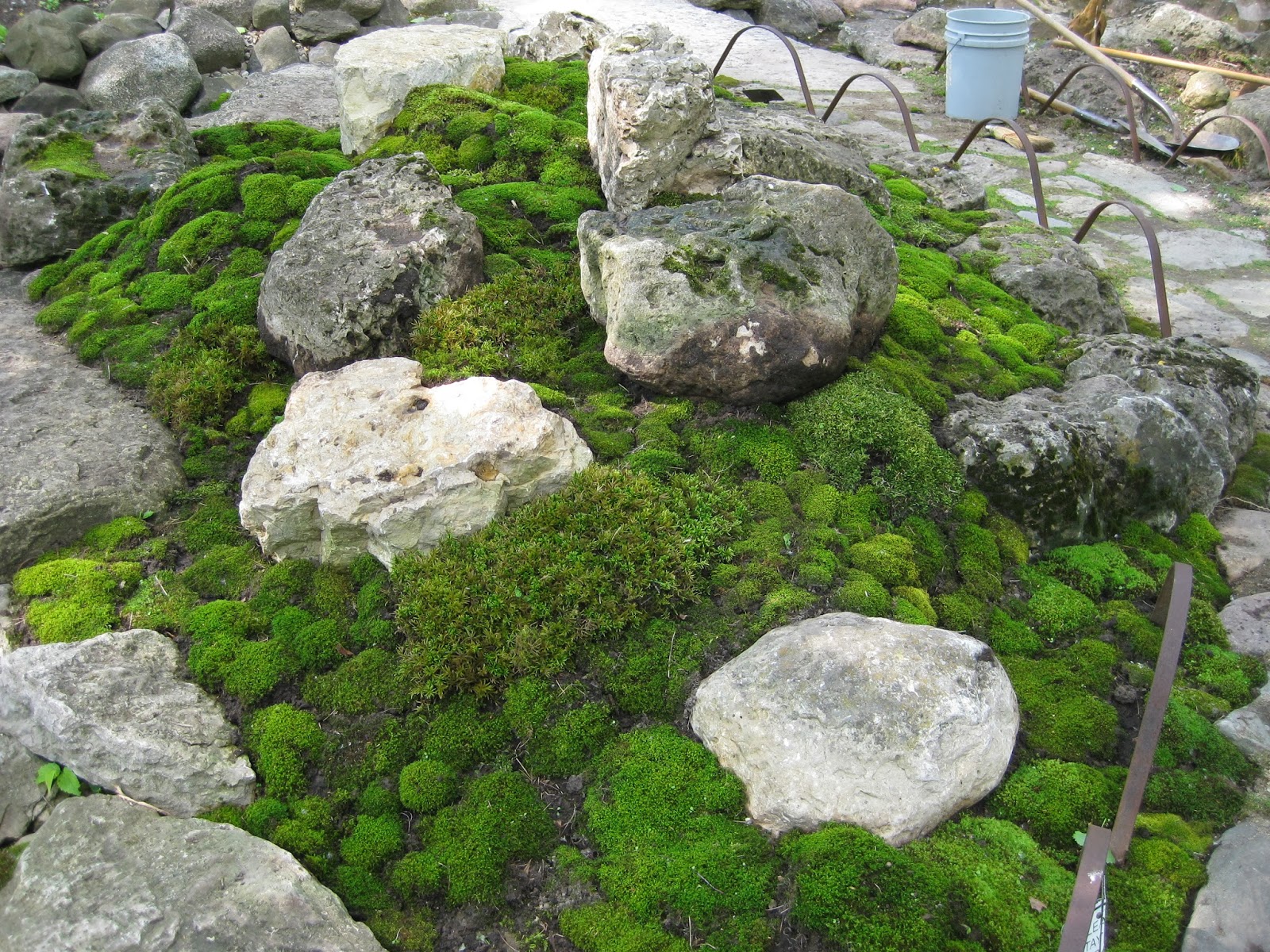
Today was the start of our second or third "polar vortices" with very sub-zero wind chill factors.  I can't imagine this will be good for some of our plants and critters outside but I'm glad that we at least have some insulating snow.  I had some fun talks over the weekend including one on ferns & mosses.  I always include some reference to "Mr. Moss" (see below) and share both photos of his home garden and recent work on the moss garden at RBG.  To say that he is a "moss enthusiast" is an understatement to say the least.  I've blogged about some of his exploits in the past but thought I'd share more photos of what he does in his own home garden.  The shot directly below and some at the bottom are from his work at RBG but the rest are from his home landscape.  His 1 acre garden (Waukesha, WI), while including lots of mossy areas, also has other themes and plantings and is one of the neatest residential gardens I've ever visited.  We'll continue to augment and encourage the mosses in our two newly renovated areas (thanks to Dale!) and are excited about promoting this primitive plant as a beautiful addition to the shade garden.  Dale is now experimenting with full sun mosses and it will be interesting to visit his garden in the near future.

With the cold, we had a smaller crew today but still saw plenty of volunteer help.  We're closed tomorrow but I'll likely come in to continue my winter research and ordering.  We have reliable painters coming in every day too. Vern, Jim and Ron Y. worked on carpentry projects while Gene continued to re-seal some of our benches.  Pat processed lights and helped Dr. Gredler with some painting.  Maury ran errands and Dick H. stopped by as well.  Bill O. came in later to help Larry out and Mary W. worked on some projects in the office.  Janice also came in for projects and we had a nice meeting of our Horticultural Therapy Committee which included Janice, Mary W., Art H., Elaine W., Darcie O. and Karen B.


With a 400 million year history, mosses have been thriving for a very long time in habitats conducive to its best growth.  There are over 12,000 species of moss worldwide with 400 native to Wisconsin alone.  I personally can't tell the difference (besides a basic visual assessment) between most although Mr. Moss has a fairly extensive knowledge of most of the local mosses.  Mosses don't have roots, flowers or seeds.  They reproduce by spores and have what are called "rhizoids" for adherence to the soil, a boulder, etc.  Their biology is amazing and I hope some of the pictures here inspire you to consider the potential of establishing mosses (by "planting" little tufts) in your home landscape.  There is a great book on Moss Gardening by George Schenk that I recommend often for those interested in this gardening opportunity (or the topic in general).


Above is "Mr. Moss" at RBG in 2012 renovating our moss islands. Below are just some of the samples that he collected and brought for installation.  He did a dynamite job along with help from Marv B., Terry, Big John and Janice.  The improvements were significant and appreciated by staff and visitors alike.  We look forward to working with Dale in the future and hope to re-visit his garden as soon as possible as well.  


Wednesday, January 22, 2014

Basils for Taste and Ornament


Of course basil (Ocimum sp.) has a long culinary history with both edible leaves and flowers.  Fresh basil is a wonderful commodity for the home cook and the dried version of this herb pales in comparison to the fresh flavor.  My wife grows plenty of standard Genovese-type sweet basil (Ocimum basilicum) in containers just outside the back door for quick and ready access.  We removed (or deadhead) any flower stalks that appear to thwart seed production and encourage more foliar growth.  Basil can and should be abused for culinary purposes but there are many varieties that also offer significant ornamental interest.  The 'Crimson King' variety above along with all the other maroon-leaf varieties can be very showy annuals in bedding schemes as well as being used for culinary purposes.  The photo below was taken at Olbrich Botanical Garden (Madison, WI) many years ago and I'm still smitten with the use of maroon basils throughout this colorful "spiral".  Our Spring Plant Sale (May 10th and 11th, pre-sale for RBG members on May 9th, 9 am - 4 pm daily) usually carries a dozen or so varieties of basil (Ocimum sp.) but many years ago, we grew a collection of over 70 varieties.  The variability in taste, color and form of these various species and varieties was truly amazing.  The culinary program at the local Blackhawk Technical College utilized much of the fresh cut basil which was a great usage.  Many of the Thai-type basils (see 'Magical Michael' and 'Siam Queen' below) have not only a different flavor but have showy flower clusters that rival any bedding plant.  We have included basils in every "ornamental edible" collection that we've created over the past decade.  They are true ornamental edibles and will thrive in the sunny border or container.  See below for just a couple to consider (and come to the plant sale in May!)

There was a very light snow all day today but it didn't amount to much on the ground.  Pat headed out in the gardens to bring back more lights and later spent time processing lights and displays inside.  Patrea was in to help with some clerical work (much appreciated) and also met with Janice and later painted.  Steve S. put a coat of primer on four garden elements that will be painted later.  Janice had multiple meetings and research today and later worked with the Chestnut House volunteers in the afternoon.  The gang created some wonderful Thank You cards that we will utilize in the near future.  Kris K. popped by for a meeting regarding some ideas for youth education out in the gardens and we also saw Maury (errands, thanks!), Chuck (recycling, thanks!), Cindy B. and many others.  I'm off the next two days but will blog as time allows. 


dark-leaved basil with sweet potato vine (Ipomoea batatas)
dark-leaved basil in a tropical composition
dark-leaved basil with coleus (Solenostemon)
'Sweet Petra Dark'
'Magical Michael'
'Siam Queen'
Ocimum hybrida 'African Blue'
'Dark Opal'
'Red Lettuce Leaf'
Ocimum sanctum (green and red mix) - Holy basil
variegated columnar Greek basil (Ocimum x citriodorum 'Pesto Perpetuo') - note the ovoid form
same as above
'Pesto Perpetuo' used as a repetitive upright element
'Pesto Perpetuo' as an accent
'Aristotle' compact basil (Ocimum basilicum) - yes, that's the cool form!
'Pluto' compact basil (Ocimum basilicum)