This is what greeted us today at the gardens. After 5 inches of rain over the weekend, strong winds and sprinkles this morning, I thought we'd have a "lost day" of staying inside. The rain held off and we really needed to get out and clean up paths. Two Bradford pears (
Pyrus calleryana) had split open due to the high winds. This is no surprise as they are notoriously soft wooded with weak branch attachments. They are a beautiful tree though. We had to remove these entirely and spent the morning cleaning up branches, debris and actually were able to do some weeding and bed preparation in the "less soggy" areas. The Grum

py turnout was great and we were able to get a nice group photo of the gang for our history brochure. Marv and Terry continued work on their limestone steps (see to the right) which are turning out awesome. Getting these steps selected, placed, leveled, backfilled, etc. is truly an art form.
Our cottonwood seedlings have already germinated around the gardens and it's a depressing sight to see the "haze" of millions (I am not kidding) little seedlings that will have to be addressed in short order. I spray many with RoundUp and we get them early with hand hoes but they have literally invaded every inch of exposed soil, cracks between bricks and along gravel paths. This is an annual event and we'll get thru it as time allows. Lots of planting on the horizon; tomorrow in fact!

In our climate, I feel the perennial with the longest "bloom window" is the yellow fumitory (
Corydalis lutea). In the image to the left, you see many specimens throughout our shade garden. It is only 12" tall with delicate, light blue/green foliage (reminiscent of bleeding heart) topped with yellow blooms from late April until hard frost in October or even November. This plant prefers part shade and tolerates a wide range of soils. It does self-sow readily so you will see colonies forming as the babies emerge. It is easy to "thin the herd" as we do every year. I'm always impressed with this plant and I can take the same picture in the same location in late September and it will look the same in terms of flower power. Highly recommended. Below is a neat shrub called dappled willow (
Salix integra 'Hakuro Nishiki') that has whitish, speckled new growth with hints of pink and salmon. Left alone, this shrub can get 8-12' tall. However, we cut it back to 6" every winter and watch the explosion of fresh new growth that will shoot up to 3-4' during the season. We do this "severe cutback" every year to encourage the most colorful growth and to also maintain a more compact size.


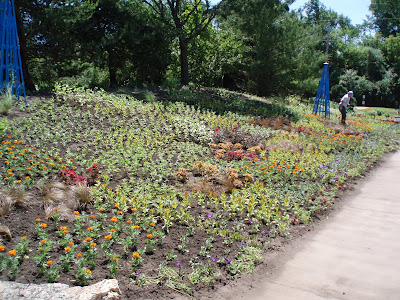 The before and after shots above sum up our productive Saturday work day. We had about 25 people show up to help plant our largest annual bed at Rotary Gardens. We put in about 6,000 annuals in this location and three other volunteers planted an additional 1,000 annuals in another location. It's nice to see our supply of "yet to be planted" diminish as a result of so much volunteer help. We'll continue to plant thru the coming weeks and are pleased with our progress thus far. More rain and flooding is on the way and will affect the gardens again. Our pond is on the rise and will probably surpass earlier "high water marks" by next Wednesday. Downtown Janesville is beginning to take on more water as well. Yes our lawns are all a lush green but what a price to pay as Mother Nature again shows us who's in charge!

 The image to the left is of the arrowwood viburnum (Viburnum dentatum) in bloom. Later this native shrub will develop blue berries (tasty for birds) and sometimes a nice fall color depending on the variety. Mature height can be 8-10' but for those that like a more compact variety, look for 'Little Joe' for half that height with all the same features. Neat, late blooming bulb below. Ornithagalum (forgot the species of this one) has come back for many years for us and has wonderful spires of clear white blooms.