Thursday, December 4, 2014

Golden Forest Grass For Impact


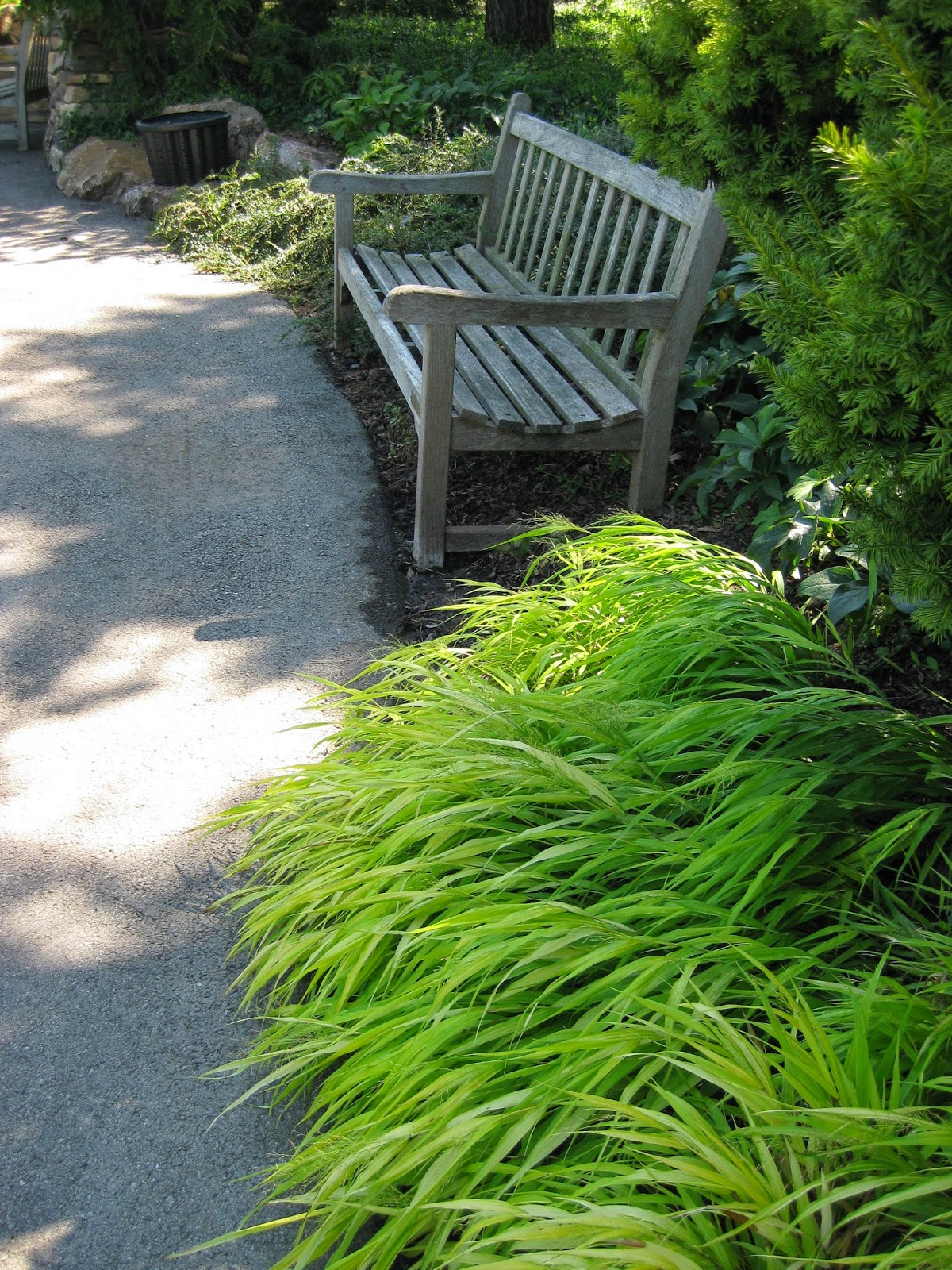
Today was another productive one with lots of volunteer help this morning.  We had a good crew of Grumpies come in to help install the remainder of our deer fencing, help re-stake trees for the Holiday Lights Show (HLS), continue carpentry projects and work on some additional HLS tasks.  Maury, Gary, Dick P. and Dick H. worked on finishing up the deer fencing around our tasty arborvitaes (Thuja occidentalis and Thuja plicata) while Larry and Marv B. re-staked the trees. Ron Y., Vern, Dave T. and Jim continued their carpentry projects while Bob K. troubleshot some more HLS issues.  Alan M. continued to clean up our tools for the winter and Janice stopped by to work on some HLS repairs out in the gardens.  We also saw Terry N., Kris K., Bev D., Deb G. and many others today.  Our last and final test night of the HLS went well tonight and I had some help from Tina and Karen.  We also saw Jim and Bonnie D., Janice and Mike P., Marsha, Sue M, Jimmy and his daughter.  The photo above of 'All Gold' Japanese forest grass (Hakonechloa macra) was certainly not taken recently but that photo and those below should inspire you to consider this grass for your partly shaded locations next year.


Japanese forest grass (Hakonchloa macra) is one of my favorites for offering color and texture in the part shade garden.  There are many varieties out there and the original species is green and can actually tolerate quite a bit of sun.  This is not a drought tolerant grass so adequate moisture, decent soils and supplemental watering (along with some mulching) are strongly recommended.  Drawbacks include slow growth and not being inexpensive.  However, this grass, when happy, can be a great addition to the partly shaded border as seen above.  Offering illumination and color, this grass contributes a range of chartreuse to gold (dependent on season of the year and available sunlight) and flowing texture.  The variety 'Aureola' is also quite popular and has a strong yellow variegation on green leaf blades.  There are some other variegated forms that feature either white variegation on green leaves or white variegation on golden leaves.  Check further on these but 'Albostriata', 'Sunny Delight', 'Stripe it Rich', 'Naomi' and 'Fubuki' are all quite nice.  Some selections have a stronger late season fall color like 'Nicolas' and 'Beni Kazi'.  However, 'All Gold' continues to be my favorite and the photos here should inspire you to look for it and use it in similar garden formats.

early growth and emergence in May
 flowering in early October
pinkish tints in late October (above and two photos below)


winter coloration seen above
 effective single specimen
 softening a path edge in a row (Olbrich Botanical Gardens, Madison, WI)
10 years ago we planted 72 plugs of 'All Gold' in the crevices of this boulder wall and it has filled out nicely as seen above and below

 winter look above
a single specimen can reach 18" tall and 30" wide
two might be better than one
soft "skirting" around this boxwood (Buxus)
above at Olbrich Botanical Gardens (Madison, WI)
used above and below as a clumping groundcover

Wednesday, December 3, 2014

Flame in December?

 
Although we've had a recent warm up (sunny and 29 degrees F today), my reference to "flame" in this blog title refers to the 'Flame' willow (Salix hybrida) seen in all of these photos at different times of the year.  The image above was taken about a week ago along the slope on the west side of the Parker Education Center where we have multiple specimens established.  This image certainly promotes the winter value of this selection with these vivid orange/red stems offering interest (comparable to the best of the red-twig dogwood for sure!).  More on this willow is shared further below.
 
Today was fairly quiet and I was able to go through three 2015 seed catalogs and I continue to prepare for 2015 tasks.  I did head out to test the lights again and did a little troubleshooting.  While the Holiday Lights Show (HLS) is essentially ready to go, it's not too early to think about our involvement at the 2015 Wisconsin Public Television Garden Expo (February 13-15).  We have had a booth at this event for over 17 years and I'm doing a record number (5) of presentations this year which are always a good venue for promoting the gardens!  Attendance at this event over recent years has hovered around 20,000 folks and the timing is perfect for those that have the winter doldrums.  Today I also saw Marv B., Dr. Yahr, Mark S. and Big John.  Bob K. came in for some afternoon tweaks on the animated displays out in the HLS and Janice stopped by in the afternoon too.
 

Some comments about the 'Flame' willow to start with are important.  This multi-stemmed plant wants to be 30' tall or more and will become a multi-stemmed tree if left alone.  However, annual pruning of this selection (to 15" tall in March) will encourage fresh new growth and a manageable size of 6'-8' in one season.  The newest stems tend to get the best winter coloration so older plants that haven't been cut back will only have the intense red on the outermost (newest) portions of the branch with softer shades of orange on older stems and trunks.  Our willows have been cut back every March since the year they were planted and have never grown over 8' tall in a season.  This size is perfect for their current locale.  The story behind the 20 or so of these willows that we have on the west bank is interesting.  We wanted something to "hold the slope" (45 degrees?) over 12 years ago when the Parker Education Center was constructed.  We planted this grouping with the intent of soil and slope stabilization (achieved) and were smitten even that first winter with the transition of green summer stems to bright red stems by December.  The photo above is a shot in early October with the stems starting to transition as the leaves become more yellow with fall color (next couple photos down).  The best coloration occurs in December and January on this slope facing the sun. 


cut stems in winter are beautiful for arrangements
 severe cutting in March (down to 12"-15" stubs)
new growth in May
'Flame' willows (Salix hybrida) in March (above) and December (below)

Tuesday, December 2, 2014

V for Verticality


Today was fairly quiet with just a few stragglers stopping in at the Horticulture Center.  Larry had some garden work outside including some final preparations for the Holiday Lights Show (HLS).  Check out our website for dates, hours and pre-purchasing of tickets for this awesome event!  It opens for the public on Friday, December 12th (4:30 pm until 8 pm, last tickets sold at 7:30 pm).  I was pecking away at my computer all day although we also saw Maury, Bill O. (helped Larry) and Dr. Yahr today. 

I haven't been inspired recently for much photography outside so am focusing on some more colorful topics to get us through the winter months.  Verticality in the garden is vital whether it's represented by plants or non-living elements.  We don't garden in two dimensions and adding narrow height as an accent can help blend a composition and create some dramatic interest with those exclamation points leading the eye or becoming focal points.  Narrow conifers, ornamental grasses and plants with very upright flowers can offer this drama and be vital in the garden.  I always preach the value of "flower architecture" as it is certainly a characteristic worthy of consideration.  Flowers certainly bloom at different times and have a wide range of colors.  However, they also have different shapes and forms like flat platforms (coneflowers), trumpets (lilies), spheres (globe thistle) and spires (salvias).  This blog is a tribute to the letter 'V' for not only verticality but Veronica sp. (speedwell) and the native Veronicastrum virginicum (Culver's root).  Both of these perennials offer upright narrow flowers that really draw the eye as these photos will reinforce.  There are a wide range of varieties for both of these sun-loving selections.  The top photo shows the standard white form of Culver's root in a late summer composition.

 
Culver's root (Veronicastrum virginicum) is a North American native perennial that loves full sun (preferred) or some light shade.  This perennial prefers moist soils and has minimal drought tolerance.  With a long history of medicinal use, this summer blooming perennial can add height (3'-7') in the sunny border with blooms lasting a good four weeks or more.  Varieties range in color from white to light pink and even light blue.  Multiple groupings of this perennial in the summer border or meadow garden will result in a pleasing repetition of vertical form when the spire-like blooms emerge above whorled foliage.  This narrow plant looks great in a grouping of 3-7 plants as seen in some examples below.  Consider this stalwart native for beauty, height, verticality and extended summer impact in your sunny garden. 
 
 Veronicastrum virginicum 'Pink Glow'
 Veronicastrum virginicum
Veronicastrum virginicum
 Veronicastrum virginicum
Veronicastrum virginicum 'Erica'
 
Speedwells (Veronica sp.), like those seen here, can offer flower verticality with colorful spires in mid-Spring.  There are some creeping and lower-statured veronicas but the spicata, longiflora and some hybrids can be selected for a profusion of upright spires (as seen on Veronica spicata 'Heidkind' directly above and below).  Most of these selections (and there are many more) hover at a 12"-15" flowering height although some varieties/hybrids will reach 24" tall.  Full sun is preferred for all veronicas and while they are quite adaptable in a wide range of soils, provide moist, well-drained situations in decent soil and you will be rewarded.  The first strong wave of blooms in mid-Spring will be followed by sporadic blooms all the way until frost.  Consider shearing these plants back severely in mid-summer to remove spent flowers and encourage fresh foliar growth and a potential resurgence of blooms.  The value of these "vertical veronicas" can be seen further below.
 
 Veronica spicata 'Heidkind'
 Veronica spicata 'Fairytale'
 Veronica spicata 'Tickled Pink'
Veronica spicata 'Royal Candles'
 Veronica longifolia 'Pink Damask'
Veronica spicata 'Red Fox'
 Veronica longifolia 'Evelyn' (above and below at Olbrich Botanical Garden in Madison, WI)
 
 Veronica incana 'Pure Silver'

Monday, December 1, 2014

Beautiful Thorns


“But he who dares not grasp the thorn should never crave the rose.” Anne Bronte
 
Today was super cold out again after a warm weekend and while there was limited activity out in the gardens, we had a decent turnout of volunteers for inside work.  Ron Y., Jim, Dave, Vern and Bob K. had some carpentry projects and odd jobs to accomplish.  Dick H. did some work on the vehicles and Maury was in to run errands and do some watering.  Alan M. stopped in for tool cleaning and we also saw Bill O., Rollie, Gary S. and many others today.  Larry salted some paths and had a combination of indoor and outdoor work while I am shifting to 2015 preparations.
 
I picked some thorny plants today for the blog where I thought the thorns were an ornamental feature.  Above and below is the porcupine tomato (Solanum pyracanthum) which has these neat orange spines in profusion.  This plant is poisonous as is the fruit.  However, its value as a novelty is apparent!  In fact, three of my thorny subjects today are in the nightshade family!   

 
porcupine tomato (Solanum pyracanthum)

porcupine tomato (Solanum pyracanthum)
Naranjilla  (Solanum quitoense) - produces edible fruit!
 same as above
 same as above
 same as above
 purple spine or malevolence (Solanum atropurpureum) - poisonous!
 same as above
 same as above
 castor aralia (Kalopanax pictus) - woody tree