Thursday, February 19, 2015

Yellow Fumitory (Corydalis lutea)


Today was FRIGID with no activity out in the gardens (except for hungry deer).  While the weather outside was frightful, the inside was so delightful (and productive).  Pat M. continued to process lights while Dr. Gredler painted more trash bins with a fresh coat of grey/blue paint.  Ron Y. and Dave were putting primer on their carpentry projects which will become the "soon to be announced" garden art projects for this year.  More to follow on that annual event very shortly.  Vern, Jim, Bob K. and Dick H. were all working on carpentry projects as well.  Larry O. was here briefly and we saw a couple others as well.

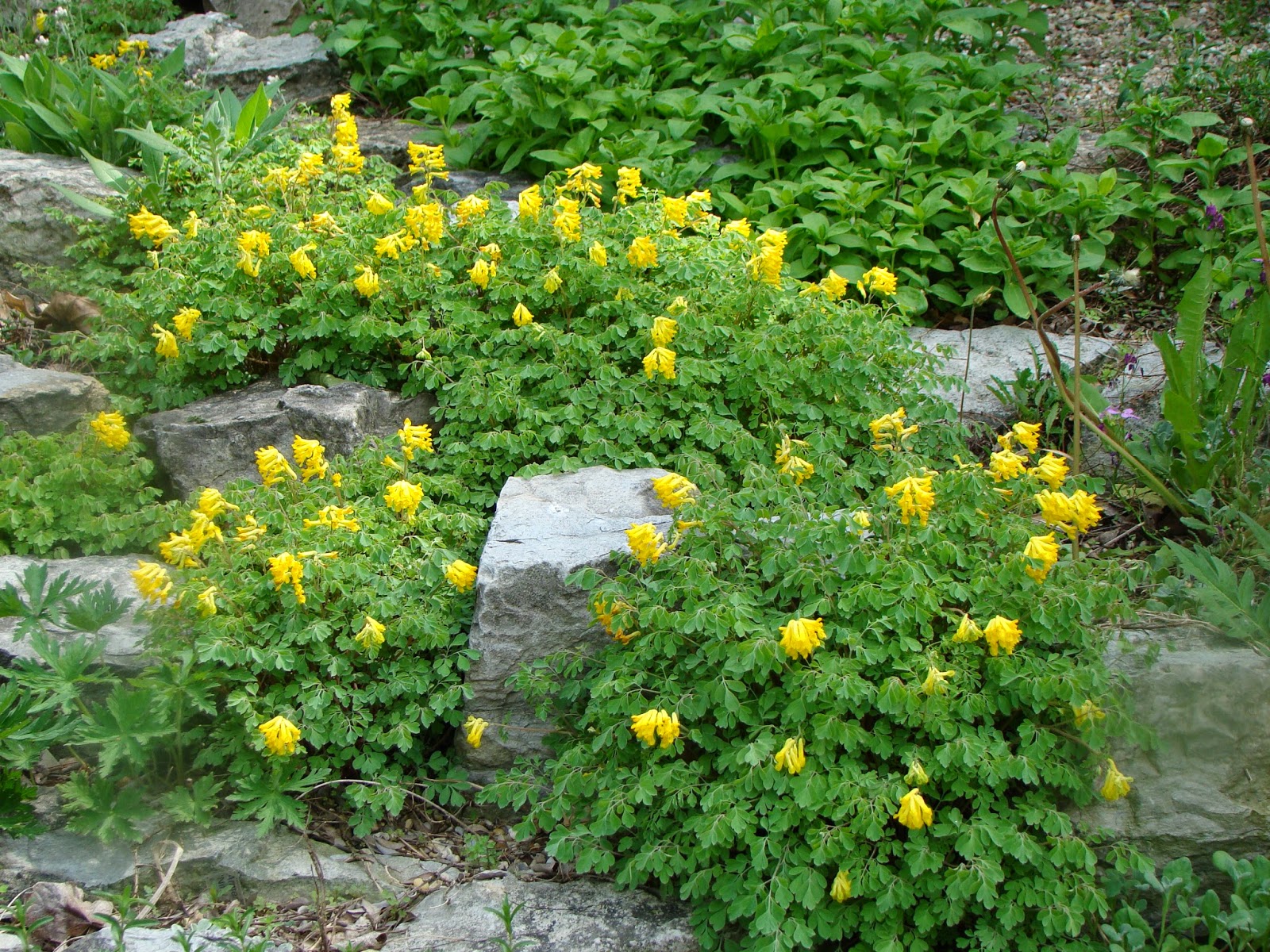
Any time I do a presentation regarding the shade garden, I include the yellow fumitory (Corydalis lutea).  This perennial has thrived for us and has been a colorful component in many of our shade and part shade gardens.  All of these images (most from RBG) will do credit to the beautiful flowers and clean foliage of this European native.  The blue-green foliage (three-lobed leaflets) is reminiscent of bleeding heart (Dicentra sp.) or even columbine (Aquilegia sp.).  Of all of our perennials (literally, all) in the garden, this one has the longest bloom period which will start in May and end in early October.  They are "self-cleaning" so simply continue to shed old blooms and produce new ones.  These plants prefer rich, moist soils and will never thrive in dry soils.  Full shade to part shade are preferred but with ample moisture, I've seen them do well in more sunlight.  Soil drainage is important as yellow fumitory will resent wet winter conditions and may disappear.  This species is hardy to only zone 5 so keep that in mind.  When happy though, this plant will reseed prolifically although seedlings are easy to remove or relocate.  The image below shows some "advantageous reseeding" throughout open gaps in our shade garden.  There were only three plants installed here five years before the photo so you can see how it spreads out.  Beautiful!  At 15" tall, this tough perennial should be included in your shade garden palette and as long as you keep it happy, it will do the same for you!




Wednesday, February 18, 2015

Black-Eyed Susan Vines

 
It was a cold day outside with wind chill temperatures below 0 degrees F.  Needless to say, we didn't have anyone out in the gardens but the progress with taking down the Holiday Lights Show (HLS) has gone very well over the last six weeks.  It's hard to believe that last year we had hardly started take down efforts because of the consistently frigid temperatures.  I'd estimate that 50% of the show is down but we still have many displays, etc. that are frozen in the ground.  I was able to continue seed ordering today and am finalizing a couple presentations including one for the RBG Spring Symposium entitled Garden Inspirations: The Spice of Life.  Held on March 21st (9 am - 3 pm), this event will feature Peter Hatch (retired Head of Gardens and Grounds at Thomas Jefferson's Monticello) and Kyle Cherek (host of Wisconsin Foodie on WPT).  Space is filling fast for this event so check it out on our website!  Janice came in for various duties including more preparations for our Spring Plant Sale (Mother's Day weekend!).  Pat was in to process lights and we saw a couple others today.
 
The blog today features the annual black-eyed Susan vine (Thunbergia alata) which has always been a great performer for us at the gardens.  This vine, native to Eastern Africa, does well in our hot summers and will typically get 6'-8' in one season.  The blooms are reminiscent of the black-eyed Susan with many having yellow or orange flowers with a dark center.  Above is the variety 'Orange Beauty' which is quite vivid in the landscape.  Although this vine has naturalized in warmer climates, it's a true annual for us and is an excellent twining vine for smaller structures in full sun and with decent soils.  The 5 petal flowers run the range of yellows, oranges, pink, near red and white.  There are an unbelievable amount of colors right now including mixes.  Some have the dark center and some varieties are without that dark throat (or "eye").  You can find a wide range of these in seed catalogs and some of the fancier new ones are vegetatively propagated so can be sought and bought as plants.  Some fun varieties can be seen below. 
 
 'Susie Orange Clear'
'White with Black Eye' (above and two below)
 

 'Arizona Dark Red'
 'Lemon A-Peel' (above and two below)
 

unknown orange variety
great "short-statured" climber! (above and below at RBG)

Tuesday, February 17, 2015

Golden Conifers in Winter

 
For us in the Midwest, the winter landscape can be a bit bleak with lots of white and brown out there.  Our "winter interest" gardens should also contain colorful stems, ornamental berries and a lot more conifers for color.  Plant form and structure also becomes more conspicuous with all of our woody plants.  Yellow in the winter landscape can be extremely ornamental and there are many conifers that can provide that interest.  There are some deciduous conifers that get a yellow fall coloration before their needles drop and there are other conifers that have yellow spring highlights and fade to green.  The focus in this blog however, is on those that will offer some degree of yellow/gold/chartreuse during those long winter months.  The photo above is the 'Yellow Ribbon' arborvitae (Thuja occidentalis) which is a common variety that shines in the winter (deer like it too though!).  In many cases, the most intense golden coloration on these selections will come in the winter months.  Some of these will also have bright growth in spring but certainly add some eye-catching interest in our dull winter landscape.  Don't forget to also include ornamental bark, berries, colorful stems, engaging plant forms and other elements for 12 months of interest! 
 
It was a quiet day at the Horticulture Center.  Larry H. was out bringing in more lights and both Bill and Larry O. were processing lights inside along with some other projects.  We also saw Gary and Dr. Yahr today and our Horticulture Therapy Committee met in the afternoon to discuss our August 11th event entitled "Incorporating Gardening Into a Therapy Program".  This all day event will have lecture components and many hands on activities.  From the description for this program..."This program is specifically designed for those that work with special populations and are interested in learning about the benefits gardening can provide their clients, as well as how it may be incorporated into a therapy program."  This event will also be of interest for the avid gardener as it will address accessibility and gardening as we age!
 
 golden Scots pine (Pinus sylvestris 'Gold Coin')
 golden Virginia pine (Pinus virginiana 'Wate's Golden') - above and below

golden Nordmann fir (Abies nordmanniana 'Golden Spreader') - above and below with a bit of winter damage

 golden lodgepole pine (Pinus contorta var. latifolia 'Chief Joseph') - above and below

 golden mugo pine (Pinus mugo 'Carsten's Wintergold')
golden hemlock (Tsuga canadensis 'Aurea Compacta')
 golden falsecypress (Chamaecyparis pisifera 'Golden Mops') - above and below

 golden falsecypress (Chamaecyparis pisifera 'Sungold')
golden falsecypress (Chamaecyparis pisifera 'Sepers Gold')
golden bird's nest spruce (Picea abies 'Repens Gold')

 golden juniper (Juniperus chinensis 'Saybrook Gold')
 golden Oriental spruce (Picea orientalis 'Skylands')
 golden mugo pine (Pinus mugo 'Aurea') - winter color
 golden white pine (Pinus strobus 'Hillside Winter Gold') - winter color
 golden Korean fir (Abies koreana 'Aurea')
golden arborvitae (Thuja occidentalis 'Holmstrup Yellow')